

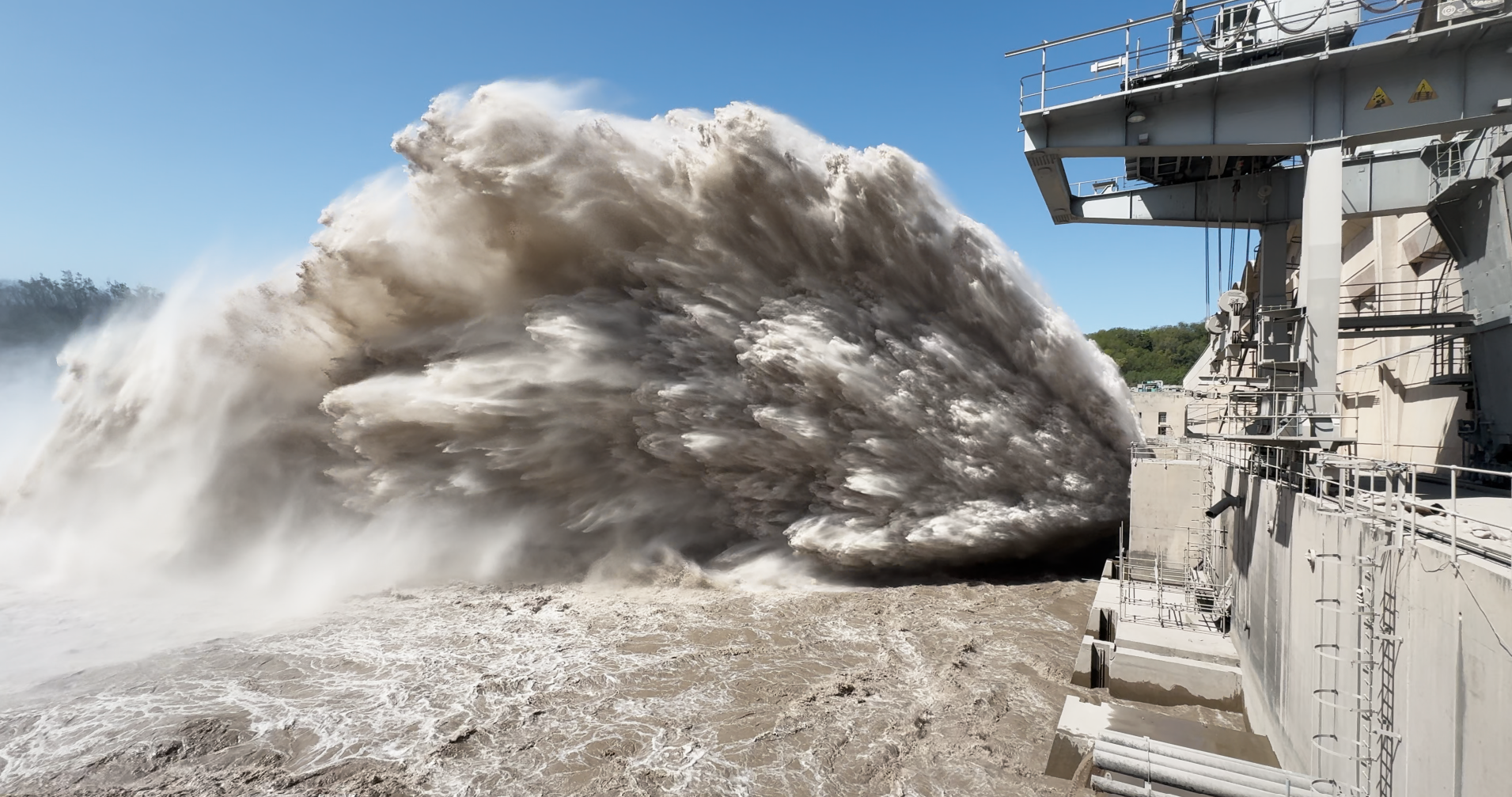
Sediment flushing is one of the most important reservoir management techniques used to control the accumulation of silt, sand, gravel, and other sediments behind dams. Over time, rivers continuously carry sediment into reservoirs. If this material is not managed, it can reduce the effective storage capacity of the reservoir, affect water intakes, increase abrasion of hydraulic machinery, and reduce the long-term performance of a hydropower project.
For hydropower dams, sediment management is therefore not simply a maintenance activity—it is an important part of reservoir operation and dam sustainability.
What Is Sediment Flushing?
Sediment flushing is a hydraulic method of removing deposited sediment from a reservoir by using flowing water.
During a flushing operation, reservoir water levels are lowered and specially designed low-level outlets, flushing tunnels, bottom outlets, or undersluice gates are opened. The resulting high-velocity flow erodes and transports deposited sediment downstream.
Unlike conventional dredging, which mechanically removes sediment, flushing uses the river’s own hydraulic energy to mobilize and transport the deposits.
Simple principle:
Reservoir sediment → Lower water level → Open flushing outlet → High-velocity flow → Sediment erosion → Sediment transported downstream


Why Does Sediment Accumulate Behind a Dam?
Natural rivers transport sediment from their upstream catchments. This sediment can include:
- Clay
- Silt
- Fine sand
- Coarse sand
- Gravel
- Organic material
- Rock fragments
When a river enters a reservoir, its flow velocity generally decreases. As the water loses carrying capacity, sediment begins settling on the reservoir bed.
The finest particles may travel farther into the reservoir, while heavier particles can settle closer to the river entrance.
Over many years, these deposits can form large sediment deltas at the upstream end of the reservoir.
Why Is Sediment Management Important?
Sediment accumulation can create several problems for dams and hydropower plants.
1. Loss of Reservoir Storage
One of the most important effects is the gradual loss of useful reservoir capacity.
If sediment occupies part of the original storage volume, less water is available for:
- Hydropower generation
- Irrigation
- Water supply
- Flood management
- Environmental releases
For reservoirs designed for long-term operation, sedimentation can become a major challenge.
2. Protection of Water Intakes
Sediment can migrate toward the intake structure, particularly when reservoir levels and flow conditions change.
Excessive sediment near an intake can create operational difficulties and increase the risk of sediment entering hydraulic machinery.
3. Turbine Abrasion
Fine sediment particles, particularly quartz-rich sand, can be extremely abrasive.
If sediment enters turbines in significant concentrations, it can contribute to wear of:
- Runner blades
- Guide vanes
- Nozzles
- Seals
- Other hydraulic components
This can increase maintenance requirements and reduce turbine efficiency.
4. Maintaining Reservoir Capacity
Regular sediment management can help preserve the useful volume of a reservoir and extend the operational life of the project.
How Does Sediment Flushing Work?
A typical flushing operation involves several stages.
Step 1: Monitoring Reservoir Conditions
Before flushing begins, operators assess conditions such as:
- Reservoir level
- River inflow
- Sediment concentration
- Sediment deposition
- Downstream flow conditions
- Weather and flood forecasts
- Condition of gates and outlets
Operational decisions must be coordinated with dam safety and downstream requirements.
Step 2: Lowering the Reservoir
The reservoir level is gradually reduced through available outlets.
This is a critical stage because lowering the water level changes the hydraulic conditions within the reservoir.
In some reservoirs, operators may need to lower the water level significantly to expose or hydraulically connect deposited sediment with the flushing channel.
Step 3: Opening the Flushing Outlet
Once the required reservoir level has been reached, the appropriate bottom outlet, low-level outlet, undersluice, or flushing gate is opened.
Water accelerates through the outlet, producing strong local flow velocities.
The flowing water begins eroding the deposited sediment.
Step 4: Formation of a Flushing Channel
As water flows through the deposited sediment, it can progressively erode a channel.
This process is known as retrogressive erosion or flushing-channel development.
The channel can extend upstream into the sediment deposit, allowing additional material to be mobilized and transported toward the outlet.


Flushing vs. Sluicing
Sediment flushing and sediment sluicing are related but different techniques.
| Sediment Flushing | Sediment Sluicing |
|---|---|
| Usually involves lowering reservoir level | Usually performed with higher reservoir levels |
| Deposited sediment is eroded and removed | Sediment is passed through before significant deposition |
| Can remove previously deposited material | Primarily prevents deposition |
| Often requires low-level outlets | Usually relies on routing sediment-laden floodwater |
| Hydraulic erosion is important | Sediment transport through the reservoir is emphasized |
In simple terms:
Sluicing tries to pass sediment through the reservoir.
Flushing tries to remove sediment that has already deposited.
What Happens to the Water During Flushing?
During flushing, water downstream of the dam can become heavily sediment-laden.
The discharge may change from relatively clear water to a dense turbid sediment-water mixture.
This is why flushing operations require careful monitoring of downstream conditions.
Important parameters can include:
- Suspended sediment concentration
- Turbidity
- Particle-size distribution
- Discharge
- Water level
- Flow velocity
- Duration of flushing
The objective is to remove sediment while keeping downstream impacts within acceptable operational and environmental limits.
Why Does Flushing Water Look So Muddy?
One of the most visually dramatic aspects of sediment flushing is the sudden change in water color.
Clear or relatively clean reservoir water can become brown, gray, or almost black as large quantities of suspended sediment are released.
The appearance depends on:
- Sediment type
- Particle size
- Organic content
- Sediment concentration
- Reservoir geology
- Flow conditions
A dense sediment plume does not necessarily mean that the dam is malfunctioning. In a planned flushing operation, the high sediment concentration may be the direct result of intentionally mobilizing deposited material.
Types of Sediment Flushing
Different reservoir configurations require different flushing approaches.
Pressure Flushing
Pressure flushing uses hydraulic pressure and flow through low-level outlets to erode deposited sediment.
Drawdown Flushing
The reservoir is significantly lowered before or during the operation, allowing flowing water to erode deposits.
Emptying Flushing
In some reservoirs, the water level is lowered substantially, sometimes approaching the original river channel, allowing extensive sediment removal.
Density Current Flushing
Sediment-laden water can form a dense current that travels along the reservoir bottom. Operators may use suitable low-level outlets to release these currents.
The appropriate technique depends on reservoir geometry, outlet configuration, sediment characteristics, hydrology, and environmental constraints.
The Role of Dam Gates
Gates are fundamental to sediment management.
Depending on the dam design, sediment may be controlled using:
- Radial gates
- Flap gates
- Sluice gates
- Bottom outlets
- Undersluice gates
- Low-level outlets
- Intake gates
- Spillway gates
Each gate serves a specific hydraulic and operational purpose.
During flushing, operators must control opening sequences and discharge carefully because sudden changes in flow can create significant hydraulic forces.
Sediment Flushing in Hydropower Projects
For hydropower dams, sediment management is closely connected to energy production.
A reservoir with excessive sediment can affect the entire hydraulic system:
River → Reservoir → Intake → Headrace/Conduit → Penstock → Turbine → Tailrace
If sediment reaches the intake and passes through the hydraulic machinery, it can cause abrasion and reduce equipment life.
Therefore, a comprehensive sediment-management strategy may combine:
- Reservoir flushing
- Sediment sluicing
- Desanders
- Sediment-exclusion structures
- Intake management
- Dredging
- Watershed management
- Turbine protection measures
How Often Should a Reservoir Be Flushed?
There is no universal flushing interval for every dam.
The required frequency depends on factors such as:
- Annual sediment inflow
- Reservoir volume
- Reservoir geometry
- Sediment grain size
- River discharge
- Flood frequency
- Available outlet capacity
- Dam design
- Environmental requirements
- Operational constraints
Some projects may conduct sediment management frequently, while others may require major flushing operations only periodically.
The key objective is to prevent sediment accumulation from reaching a level where it threatens the reservoir’s intended function.
Challenges During Sediment Flushing
Sediment flushing is a powerful technique, but it is not without challenges.
Downstream Sediment Impacts
Large sediment releases can temporarily increase turbidity and sediment concentration downstream.
Gate and Outlet Abrasion
High concentrations of abrasive particles can increase wear on gates, outlets, concrete surfaces, and other hydraulic components.
Reservoir Drawdown
Rapid changes in reservoir level can affect slopes, shorelines, infrastructure, and sediment deposits.
Limited Flushing Efficiency
Not every reservoir can remove all deposited sediment. Flushing effectiveness depends strongly on reservoir geometry and the location and capacity of outlets.
Environmental Considerations
Aquatic ecosystems and downstream water users may be affected by sudden changes in sediment concentration and flow.
Consequently, flushing should be treated as an engineered reservoir-management operation, rather than simply opening a gate and releasing water.
Sediment Monitoring Before and After Flushing
Monitoring is essential for determining whether flushing has achieved its objective.
Engineers may compare:
- Reservoir bed levels
- Cross-sectional surveys
- Sediment volumes
- Sediment concentration
- Particle-size distribution
- Turbidity
- Outlet discharge
Bathymetric surveys are particularly useful for determining where sediment has accumulated and how much material has been removed.
A comparison of pre-flushing and post-flushing reservoir surveys can provide valuable information about the effectiveness of the operation.
Is Sediment Flushing a Waste of Water?
A common question is:
Why release water from a reservoir instead of using it for power generation or water supply?
The answer depends on the long-term objective of the reservoir.
If sediment is allowed to accumulate indefinitely, the reservoir can progressively lose its useful storage and the hydropower system may face increasing operational and maintenance problems.
Therefore, water released during a carefully planned flushing operation can be viewed as part of long-term reservoir management rather than simply wasted water.
The challenge is to balance:
Water utilization + Power generation + Sediment removal + Downstream protection
Future of Sediment Management
Climate variability, changing watershed conditions, deforestation, landslides, extreme rainfall, and changing flood patterns can influence sediment inflow into reservoirs.
Modern dam management increasingly relies on:
- Bathymetric surveys
- Remote sensing
- Sediment sampling
- Real-time turbidity monitoring
- Numerical hydraulic modeling
- Sediment transport modeling
- Automated gate control
- Watershed sediment management
Combining these technologies can help engineers make better decisions about when and how to operate sediment-management facilities.
Conclusion
Sediment flushing is an important technique for maintaining the long-term performance of dams and hydropower reservoirs.
By using controlled hydraulic flows to erode and transport deposited sediment, flushing can help preserve reservoir storage, protect water intakes, reduce sediment accumulation, and support sustainable hydropower operation.
However, successful flushing requires careful engineering, reservoir monitoring, gate operation, hydraulic assessment, and consideration of downstream environmental conditions.
Ultimately, sediment is a natural part of every river system. The challenge for dam engineers is not simply to remove it, but to manage sediment intelligently throughout the entire life of the reservoir.
🔎 SEO Keywords
sediment flushing in dams, sediment flushing, reservoir sediment management, dam sediment removal, sediment management in hydropower, reservoir silt removal, silt flushing in dams, sediment flushing operation, hydropower dam sediment, bottom outlet flushing, dam flushing gates, reservoir sedimentation, sediment accumulation in reservoirs, sediment sluicing, sediment transport, reservoir management, hydropower reservoir, dam gates operation, sediment erosion, flushing channel, sediment monitoring, turbine sediment abrasion, dam engineering
Suggested SEO Title
Sediment Flushing in Dams: How Hydropower Reservoirs Remove Silt & Sediment
Alternative Titles
- How Dams Flush Millions of Tons of Sediment
- Sediment Flushing Explained: How Dams Remove Silt
- Inside a Dam Sediment Flushing Operation
- How Hydropower Dams Fight Reservoir Sedimentation
- Why Dams Release Muddy Water | Sediment Flushing Explained
Thumbnail Text
WHERE DOES ALL THE SILT GO?
or
DAM FLUSHING EXPLAINED
or
MILLIONS OF TONS OF SEDIMENT!
For your website, I’d recommend using “Sediment Flushing in Dams” as the main keyword and building related articles around radial gates, bottom outlets, desanders, reservoir sedimentation, and turbine abrasion so they can internally link together as a hydropower engineering content cluster.