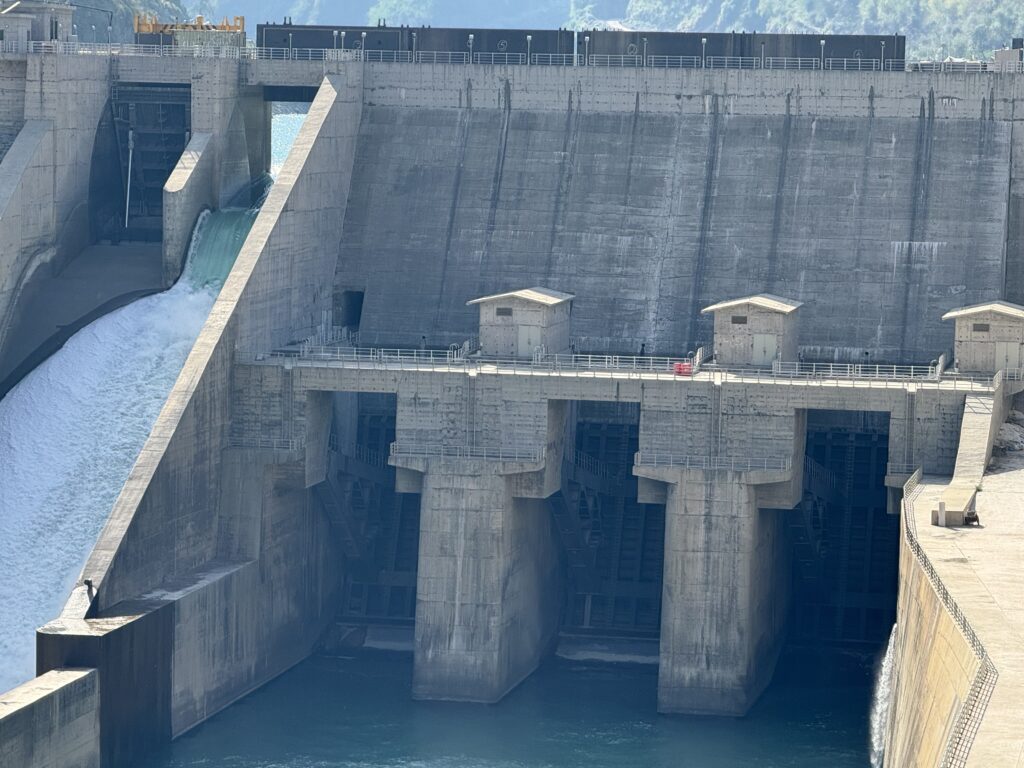
Welcome, engineering professionals and seismic analysts! Are you curious about how a towering concrete dam can resist the raw forces of nature—water pressure, uplift, hydrodynamic loads, and even the tremors of a megathrust earthquake? Dive into this post to uncover the science behind Nauseri Dam’s 2‑D Finite Element Analysis (FEA) that guarantees structural safety for the Neelum–Jhelum Hydroelectric Project.
1️⃣ Purpose & Scope
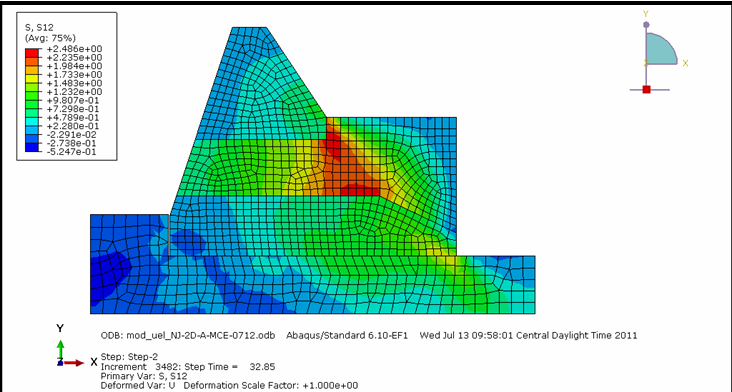
What we did: Two representative sections (A along the river; B across it) were modeled in Abaqus to simulate seismic, hydrostatic, and hydrodynamic loading.
Why it matters: Understanding these loads ensures that downstream stability and post‑earthquake performance are within acceptable limits.
2️⃣ Material Properties – The Building Blocks of Safety
3️⃣ Numerical Modeling – Bringing the Real World Into a Virtual Domain
3.1 Geometry & Mesh
Section A spans riverbank piers, using plane strain elements for the concrete and foundation.
Section B uses varying thickness to capture cross‑stream geometry (spills in across valley).
Key Takeaway: The mesh density is optimized to capture non‑linear behavior where it matters—20 m of nonlinear rock near toe, beyond that linear elastic.
Cross‑River Section B: Interfaces closed under OBE; minor openings (< 2.5 cm) under MCE—no impact on stability.
🔗 Call‑to‑Action – Why Your Project Should Read This
👉 Want to dive deeper? Download the full PDF (34 pages) and explore our technical methodology in detail.
📚 Technical Glossary
Term
Definition
Factor of Safety (FoS)
Ratio of resisting forces to driving forces along a potential slip plane.
Rayleigh Damping
Frequency‑dependent damping using mass and stiffness coefficients α, β.
Uplift Pressure
Hydrostatic pressure acting opposite the foundation’s weight, computed via water gradient.
Equivalent Plastic Strain (EPS)
Measure of yielding in rock under seismic loads.
🚀 Closing Thought
The Nauseri Dam’s 2‑D FEA stability analysis demonstrates that even a mega‑earthquake will not lead to catastrophic sliding or failure. By understanding the underlying mechanics—material properties, interface behaviour, and wave propagation—you can appreciate how this project protects communities, ensures structural integrity, and maintains resilience in seismic zones.
Share your thoughts on how such analyses influence your design decisions!